
 Posted by
 GEO Satellite Orbit Calculator
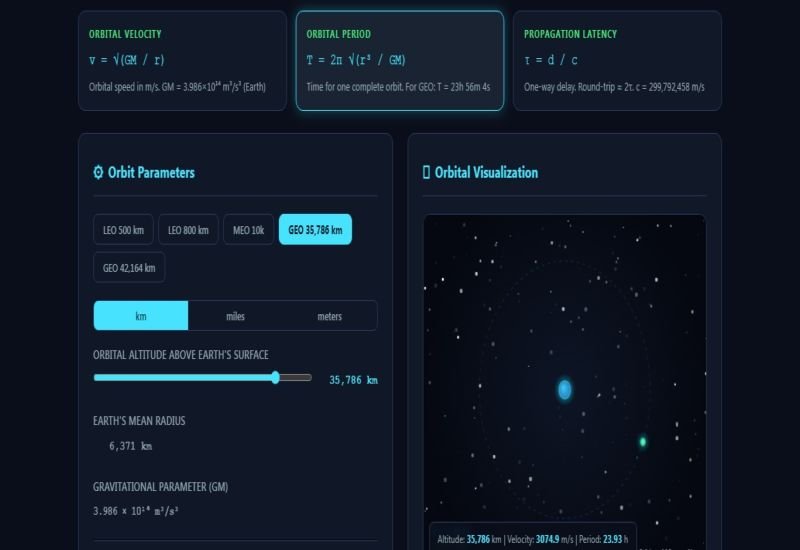
Explore our free interactive GEO Satellite Orbit Calculator designed for VSAT engineers, students and satellite professionals. Instantly calculate orbital velocity, orbital period, angular velocity and one-way/round-trip propagation latency for any altitude from LEO to GEO. Based on ITU-R P.2109 recommendations and real-world constants (GM, Earth radius, speed of light). Features live orbital animation, altitude presets (500 km, 800 km, 10,000 km, 35,786 km), unit conversion (km/miles/meters) and a clear comparison table of LEO, MEO and GEO performance. Perfect for link budget planning, latency analysis and educational use in satellite communications.
🛰️ GEO Satellite Orbit Calculator
Simulator #1 — Orbital Velocity, Period & Latency for Geostationary Earth Orbit
⚙️ Orbit Parameters
🌍 Orbital Visualization
📊 Orbit Type Comparison (ITU-R P.2109 Reference)
| Orbit Type | Altitude (km) | Orbital Velocity (m/s) | Period | Round-Trip Latency | VSAT Application |
|---|
📚 ITU References & Source Documentation
1. ITU-R Recommendation P.2109 — "Propagation data and prediction methods required for the design of earth stations"
Used for orbital mechanics parameters including orbital velocity (v = √(GM/r)) and orbital period (T = 2π√(r³/GM)). Section §1.1.2 defines geostationary orbit characteristics.
2. ITU-R Recommendation P.618 — "Propagation effects relevant to satellite service
Reference for satellite link parameters. Section §4 covers system noise temperature and G/T ratio derivations used in conjunction with orbital parameters.
3. ITU-R Recommendation P.2575 — "Key characteristics and test methods for earth stations
Used for link margin calculations and reference thresholds. Provides the framework for determining required C/N₀ ratios based on orbit type.
4. ITU-R Recommendation P.838 — "Propagation data and prediction methods required for the assessment of satellite communication systems at frequencies above about 6 GHz"
Reference for rain attenuation models (A_rain = k × R^a) that affect effective orbital performance assessment at various altitude regimes.
5. Book Reference: "VSAT, SCPC/DAMA Systems: Parameters, Dependencies & ITU Formulas"
Chapter 1, Section 1.1.2 (Orbital Mechanics), page 3. Defines GEO altitude (35,786 km), orbital period (23h 56m 4s), and the relationship between altitude, velocity, and propagation delay.
Key Constants Used
GM (Earth gravitational parameter): 3.986004418 × 10¹⁴ m³/s³ | R_earth (mean radius): 6,371 km | c (speed of light): 299,792,458 m/s | π: 3.14159265359