
 Posted by
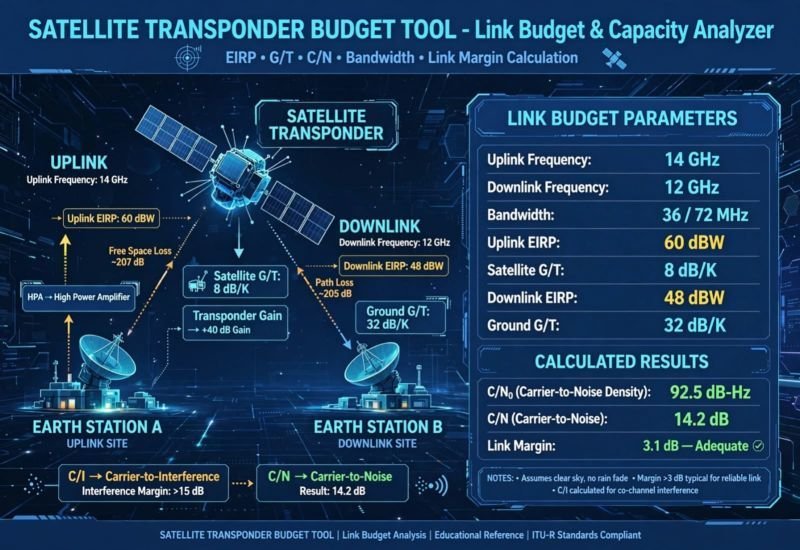
 Satellite Transponder Budget Tool
Use the Satellite Transponder Budget Tool to calculate link budgets, transponder power, bandwidth, EIRP, and satellite communication parameters.
🛰️ Satellite Transponder Budget Tool
Simulator #5 — IBO/OBO Calculation, Bandwidth Allocation & Power Budgeting
📡 Transponder Parameters
📊 Back-Off Results
📋 Complete Transponder Budget
📊 Power Budget Table
📡 Bandwidth Allocation
🔄 Carrier Configuration Comparison
📚 ITU References & Source Documentation
1. ITU-R Recommendation S.740 — "Intermodulation products in satellite services"
Defines IBO and OBO concepts for transponder operation. Establishes that satellites must operate with back-off to prevent spectral regrowth from third-order intermodulation products. Section §3 specifies the relationship between operating power and saturation power, and the associated spectral consequences.
2. ITU-R Recommendation P.618 — "Propagation effects relevant to satellite service"
Section §4 covers satellite Earth station parameters including G/T, EIRP, and C/N₀ requirements. Section §7 addresses rain attenuation which affects transponder power margins and link budget verification.
3. ITU-R Recommendation M.1036 — "Satellite Earth stations and systems — Orbital and sub-system parameters"
Provides standardized transponder parameters including bandwidth allocations (36, 54, 72, 108 MHz), frequency plans, and transponder specifications for different satellite platforms.
4. ITU-R Recommendation W.46 — "Space stations and systems"
Defines satellite system parameters including bandwidth allocation rules, carrier spacing standards, and multiple access methodologies (FDMA, TDMA, SCPC).
5. ITU-R Recommendation P.2575 — "Key characteristics and test methods for earth stations"
Defines received power density specifications and earth station performance parameters used in transponder budget verification.
6. Book Reference: "VSAT, SCPC/DAMA Systems: Parameters, Dependencies & ITU Formulas"
Chapter 1, Section 1.3 (Transponder Basics), page 3. Defines transponder architecture including TWTA saturation characteristics, IBO/OBO concepts, bandwidth allocation methods, and carrier configurations. Provides the fundamental relationships between transponder power, bandwidth, and operating parameters.
Key Constants & Reference Values
TWTA Saturation Power: 25–80 dBW (platform dependent) | Standard Bandwidths: 36/54/72/108 MHz | Typical Guard Band: 1–5% | Line Loss: 0.3–1.5 dB | C/N₀ Required: 8–12 dB [ITU-R P.2575]