
 Posted by
 Frequency Reuse Pattern Simulator
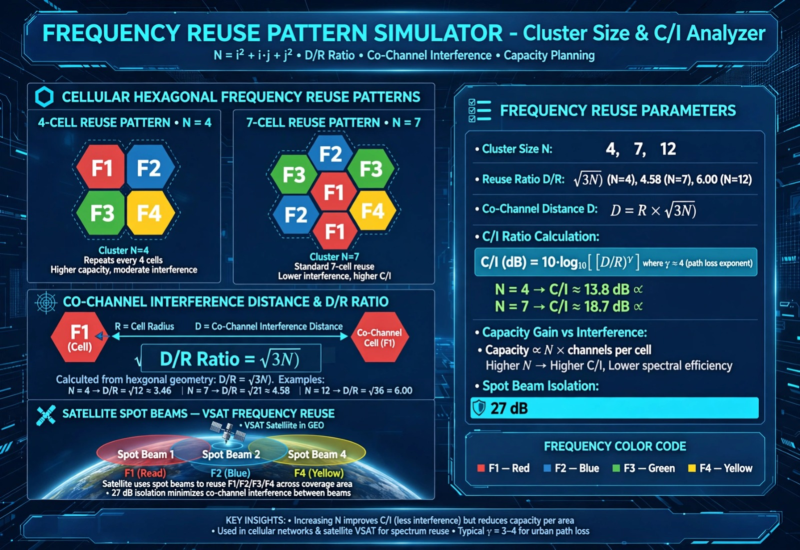
Use the Frequency Reuse Pattern Simulator to explore frequency allocation, cell patterns, interference, reuse factors, and wireless network capacity.
📡 Frequency Reuse Pattern Simulator
Simulator #6 — FDD vs TDD, Reuse Factor, C/I Ratio & Interference Analysis
🔄 Multiple Access Mode
🧩 Frequency Reuse Grid
📶 FDD vs TDD Comparison
| Parameter | FDD | TDD | FDAR | DAMA |
|---|---|---|---|---|
| Duplex Method | FDD | TDD | FDAR | DAMA |
| Bandwidth Required | 2× Forward | Shared | Adaptive | Dynamic |
| Interference | Low (separated) | Time-based | Freq-agile | Stat-free |
| Spectrum Efficiency | Moderate | High | Very High | Highest |
| Latency | Low | Variable | Low | Variable |
| VSAT Application | Broadcast | Interactive | Mobile | Enterprise |
| Sync Requirement | Low | High | Medium | High |
⚡ Co-Channel Interference Visualization
📈 Spectrum Utilization vs Reuse Factor
📐 Reuse Factor Pattern Details
Common Reuse Patterns
| Pattern | F | i,j | C/I (dB) | Use |
|---|---|---|---|---|
| 1/1 | 1 | 0,0 | ∞ | Omnidirectional |
| 1/3 | 3 | 1,0 | 18.5 | Urban macro |
| 1/4 | 4 | 1,1 | 18.0 | Standard |
| 1/7 | 7 | 2,1 | 20.5 | Classic cellular |
| 1/9 | 9 | 2,2 | 22.2 | High density |
| 1/12 | 12 | 3,1 | 23.5 | Low interference |
| 1/13 | 13 | 3,2 | 24.1 | Ultra-low |
C/I Thresholds [ITU-R S.740]
ITU Band Plans for FDD
| Band | Uplink | Downlink | Duplex |
|---|---|---|---|
| L | 1.6 GHz | 1.5 GHz | 250 MHz |
| S | 2.5 GHz | 2.0 GHz | 500 MHz |
| C | 6.425 GHz | 3.7 GHz | 2725 MHz |
| Ku | 14.5 GHz | 10.95 GHz | 3550 MHz |
| Ka | 30.5 GHz | 20.2 GHz | 10300 MHz |
📚 ITU References & Source Documentation
1. ITU-R Recommendation S.740 — "Intermodulation products in satellite services"
Defines co-channel interference (CCI) and adjacent channel interference (ACI) standards. Establishes C/I threshold of 18 dB minimum for cellular systems and provides formulas for calculating interference from co-channel and adjacent-channel transmitters. Section §3 specifies the relationship between reuse factor and interference performance.
2. ITU-R Recommendation M.1036 — "Satellite Earth stations and systems — Orbital and sub-system parameters"
Provides standardized frequency reuse parameters including cluster size definitions (F = i² + ij + j²), frequency assignment plans, and bandwidth allocation for satellite systems. Defines the hexagonal cell model and reuse patterns used in all satellite network planning.
3. ITU-R Recommendation P.618 — "Propagation effects relevant to satellite service"
Section §7 addresses rain attenuation and atmospheric effects on frequency reuse performance. Higher frequency bands (Ka) experience greater interference degradation due to rain fade, affecting effective reuse patterns.
4. ITU-R Recommendation W.46 — "Space stations and systems"
Defines frequency coordination requirements between satellite systems, interference assessment methodologies, and the framework for frequency reuse planning across different orbit types and service areas.
5. ITU-R Recommendation P.2575 — "Key characteristics and test methods for earth stations"
Defines receive performance standards and interference rejection requirements for earth stations operating in frequency reuse environments.
6. Book Reference: "VSAT, SCPC/DAMA Systems: Parameters, Dependencies & ITU Formulas"
Chapter 1, Section 1.4.1 (Frequency Reuse), page 3. Defines FDD vs. TDD frequency reuse patterns, geographic vs. spatial separation, reuse factor calculations, and co-channel interference analysis for VSAT network planning.
Key Formulas Summary
Cluster Size: F = i² + ij + j² |
C/I Ratio: C/I = 12 / (i² + ij + j²)^(q/2), q = 4 [ITU-R S.740]
Spectral Efficiency: η = B_total / (F × B_channel)
FDD Bandwidth: BW_total = BW_uplink + BW_downlink + Guard
TDD Bandwidth: BW_total = BW_uplink + BW_downlink (shared frequency)
FDAR: Dynamic frequency assignment based on traffic load
DAMA: Demand Assigned Multiple Access with statistical multiplexing