
 Posted by
 Free Space Path Loss Calculator
Our Free Space Path Loss Calculator (FSPL) is quickly and accurately with our VSAT Simulator. Everything as per ITU standards and reference to same and formulas used
📡 Free Space Path Loss (FSPL) Calculator
Simulator #3 — Real-Time Satellite Link Path Loss Analysis
🔧 FSPL Parameters
📊 Results
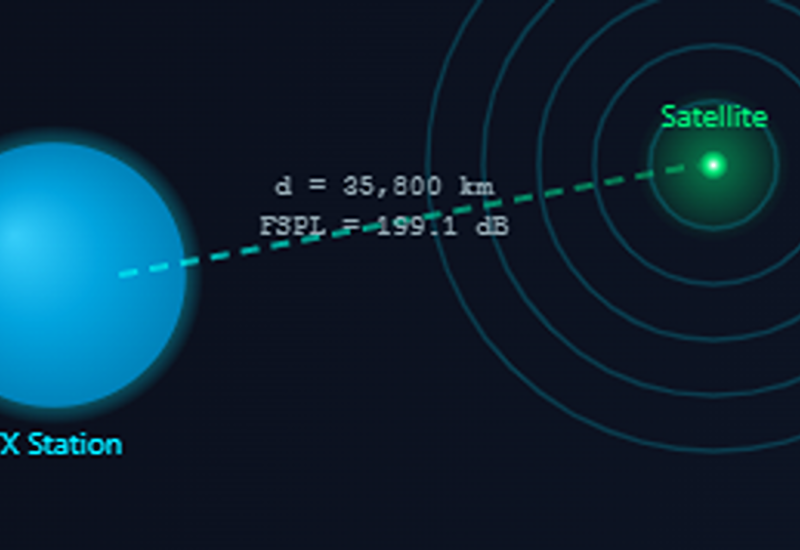
📡 Signal Propagation
📋 Link Budget Summary
📈 FSPL vs Frequency (Multiple Distances)
📉 FSPL vs Distance at Current Frequency
Logarithmic distance axis showing how path loss grows with range at the selected frequency.
📚 ITU References & Source Documentation
1. ITU-R Recommendation P.618 — "Propagation effects relevant to satellite service"
Section §6 provides the free-space path loss formula: L_fs = 92.45 + 20log₁₀(f_GHz) + 20log₁₀(d_km) for frequencies from 1 to 30 GHz. Section §7 addresses atmospheric attenuation, rain, and gaseous absorption models used in comprehensive link budget calculations.
2. ITU-R Recommendation P.2109 — "Propagation data and prediction methods required for the design of earth stations"
Provides the physical derivation of free-space path loss from electromagnetic wave propagation theory: L_fs = 20log₁₀(4πd/λ). Establishes the relationship between distance, wavelength, and signal attenuation in free space.
3. ITU-R Recommendation P.2575 — "Key characteristics and test methods for earth stations"
Defines the link margin requirements, G/T thresholds, and received power density specifications. Used to validate the received power results in this calculator against ITU standards.
4. ITU-R Recommendation P.838 — "Propagation data for frequencies above 6 GHz"
Provides rain attenuation coefficient values (k, a) for each frequency band. These are used in the link budget to add atmospheric attenuation to the free-space path loss for realistic link analysis.
5. Book Reference: "VSAT, SCPC/DAMA Systems: Parameters, Dependencies & ITU Formulas"
Chapter 4, Sections 4.1–4.5 (Link Budget Analysis), pages 6–7. The FSPL formula forms the foundation of all satellite link budget calculations. The Friis transmission equation is used to derive received power from transmitted power, antenna gains, and path loss.
Key Constants Used
Speed of light (c): 299,792,458 m/s | Reference distance (d₀): 1 km | Reference frequency (f₀): 1 GHz | FSPL constant: 92.45 dB (at f=1 GHz, d=1 km)