
 Posted by
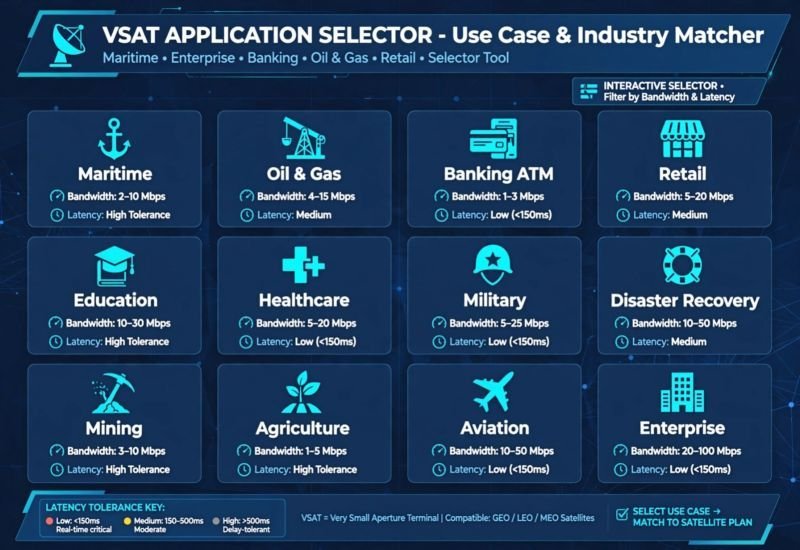
 VSAT Application Selector
VSAT Application Selector helps you explore suitable VSAT applications based on network requirements, connectivity needs, use cases, and satellite communication scenarios.
📋 VSAT Application Scenario Selector
Simulator #13 — Enterprise, SNG, Maritime, Cellular Backhaul, IoT/SCADA
🏢 Select Application Scenario
⚙️ Recommended System Parameters
📡 Application Description
💡 Key Considerations
📊 Link Budget Template
| Parameter | Value | Unit |
|---|
🔧 Component Requirements
💰 Application Cost & Capacity Comparison
📚 ITU References & Source Documentation
1. ITU-R Recommendation S.740 — "Intermodulation products in satellite services"
Defines application-specific link budgets and system parameters for VSAT networks. Section §4 specifies the relationship between application type and transponder requirements. Establishes capacity and efficiency parameters for each scenario type.
2. ITU-R Recommendation P.618 — "Propagation effects relevant to satellite service"
Section §7 provides rain attenuation models for availability calculations. Section §4 defines link budget parameters. Different applications have different availability targets: Enterprise ≥99.5%, SNG ≥99.9%, Maritime ≥99.0%.
3. ITU-R Recommendation P.2575 — "Key characteristics and test methods for earth stations"
Defines the receive performance standards and availability requirements for different VSAT application categories. Sets the benchmark for C/N₀ requirements and antenna pointing accuracy.
4. ITU-R Recommendation M.1036 — "Satellite Earth stations and systems"
Provides standardized parameters for different VSAT application scenarios including antenna sizes, bandwidth allocations, and system configurations.
5. ITU-R Recommendation W.46 — "Space stations and systems"
Provides the framework for satellite-based communication system design, including application-specific requirements, interference management, and frequency coordination.
6. Book Reference: "VSAT, SCPC/DAMA Systems: Parameters, Dependencies & ITU Formulas"
Chapter 2, Section 2.4 (Application Scenarios), page 4. Defines five primary VSAT application scenarios: Enterprise, SNG (Synthetic News Gathering), Maritime, Cellular Backhaul, and IoT/SCADA (Internet of Things / Supervisory Control and Data Acquisition). For each scenario, specifies recommended system parameters including bandwidth, modulation, FEC, antenna size, terminal type, and cost estimates.
Application Reference Values
Enterprise: 6–16 Mbps, QPSK, 1.2–1.8 m antenna, 99.5% availability
SNG: 6–36 Mbps, 8-PSK/16-QAM, 0.6–1.2 m antenna, 99.9% availability
Maritime: 0.5–5 Mbps, BPSK/QPSK, L-band, 99.0% availability
Cellular: 10–100 Mbps, 16-QAM, 1.2–4.5 m antenna, 99.5% availability
IoT/SCADA: 0.1–2 Mbps, BPSK, 0.6–1.2 m antenna, 99.0% availability