
 Posted by
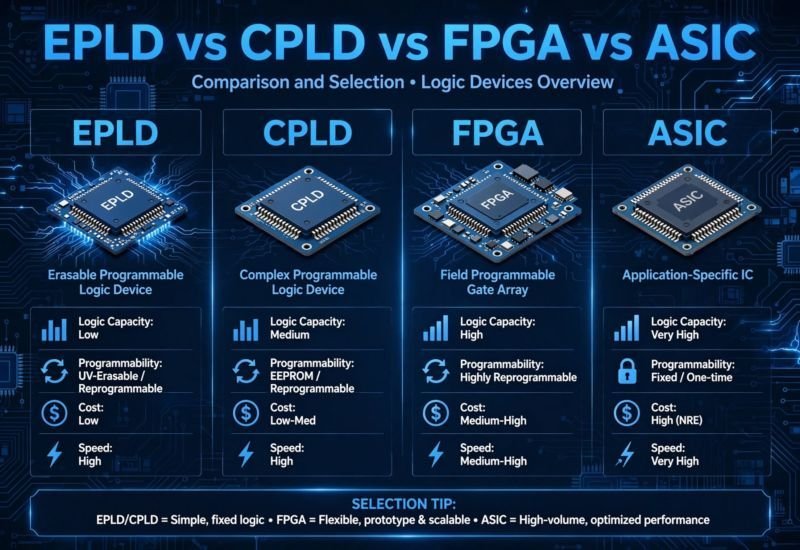
 EPLD vs CPLD vs FPGA vs ASIC
EPLD vs CPLD vs FPGA vs ASIC: Compare logic capacity, programmability, cost, speed & NRE. Learn how to select the right programmable logic device for your design.
SILICON DECISION ARCHITECT :: EPLD | CPLD | FPGA | ASIC EVALUATION PLATFORM
📱 Mobile Optimized • Enterprise Edition • Cost • Speed • Flex • Power Matrix👆 Swipe tabs left/right • All diagrams scroll sideways on phone
WHAT IS THIS COMPARATOR?
This tool compares 4 IC technologies across 7 dimensions: Logic Density, Timing Model, Power, Volatility, Boot Latency, NRE Financial Risk, Reconfigurability. For novice to expert.
Quick Guide: EPLD = Small, UV erasable, PALs together. CPLD = Many Function Blocks + GIM, instant-on, predictable timing. FPGA = LUTs + routing + hard blocks, huge, reconfigurable, volatile. ASIC = Full custom mask, cheapest per unit at high volume, highest NRE, no reconfig.
EVOLUTION ROADMAP
EPLD (1983)
2-8 PAL blocks, UV erasable EPROM, 1k-5k gates, non-volatile, 0ms boot, low power, replaces many PALs. Obsolete but concept lives in CPLD.
CPLD (1987)
4-32 Function Blocks (16 macrocells each) + central GIM. Flash non-volatile, instant-on <1ms, ultra-low standby, deterministic pin-to-pin timing. Best for glue, power sequencing, boot control.
FPGA (1985)
Sea of LUTs + FFs + programmable routing + Block RAM + DSP + PLL + ARM CPU. SRAM volatile needs external flash, infinite reconfigurable, 20M+ cells, variable timing after place & route. Best for AI, 5G, video, prototyping.
ASIC (Full Custom)
Full mask, standard cells, 1B+ gates, optimized timing, ultra-low power/Hz, hard mask non-volatile, <1ns boot, high NRE $1M+, no reconfig. Best for high volume >100k units, ultra-low power, high frequency.
SELECT TECH TO VISUALIZE:
EPLD
↔️ Scroll diagram sideways • Bright arrows show signal flow
COST ANALYSIS & BREAK-EVEN CALCULATOR
Expected Volume (units)
50,000 units
ASIC NRE Mask Cost ($)
$1,500,000
ASIC Unit Cost ($)
$5.00
FPGA Unit Cost ($)
$35.00
Total Cost @ Volume
$1,750,000
ASIC: NRE + (Unit x Vol)
$1,750,000
FPGA: Unit x Vol + $25k NRE
BREAK-EVEN ANALYSIS
EPLD Timing
Tpd = 10-15ns fixed. Input -> AND (programmable) -> OR -> Output. Deterministic. Good for simple decoders. No clock tree issues.
Tpd fixedNo STA needed
CPLD Timing
Tpd = 5-10ns fixed pin-to-pin. All paths via central GIM with uniform delay. Predictable, can calculate worst-case before routing. <1ms instant-on. Best for synchronous glue.
Pin-to-pin fixedInstant-on
FPGA Timing
Variable timing - depends on placement & routing. Need STA (Static Timing Analysis). LUT delay ~0.5ns + routing 1-10ns. Can run 500MHz-1GHz+ with pipelining. Has PLL, DSP, high-speed transceivers up to 112Gbps.
Variable STA500MHz+
ASIC Timing
Fully optimized, custom standard cells, lowest Tpd, highest Fmax (2-5GHz+). Custom clock tree, no programmable overhead. <1ns boot. Best for ultra-high frequency and lowest power/Hz.
Optimized 2GHz+<1ns boot
FLEXIBILITY & RECONFIGURABILITY COMPARISON
EPLD
UV erasable EPROM. Erase with UV lamp 20min. Reprogram via programmer. ~100 cycles. Non-volatile but inconvenient. Low flexibility.
Low Flex
UV erasable EPROM. Erase with UV lamp 20min. Reprogram via programmer. ~100 cycles. Non-volatile but inconvenient. Low flexibility.
Low Flex
CPLD
Flash/EEPROM 10k cycles, ISP via JTAG. Non-volatile, instant-on. Cannot do partial reconfig. Good for field updates but limited.
Medium Flex
Flash/EEPROM 10k cycles, ISP via JTAG. Non-volatile, instant-on. Cannot do partial reconfig. Good for field updates but limited.
Medium Flex
FPGA
SRAM infinite reconfig, ISP JTAG, external flash, dynamic partial reconfiguration (DPR) - reprogram part while rest runs! Perfect for prototyping, AI model switching, 5G waveform agility.
Infinite Flex
SRAM infinite reconfig, ISP JTAG, external flash, dynamic partial reconfiguration (DPR) - reprogram part while rest runs! Perfect for prototyping, AI model switching, 5G waveform agility.
Infinite Flex
ASIC
Hard mask, no reconfig. Once tape-out, cannot change. Need new mask $500k-$5M for any fix. Zero flexibility but zero overhead.
No Flex
Hard mask, no reconfig. Once tape-out, cannot change. Need new mask $500k-$5M for any fix. Zero flexibility but zero overhead.
No Flex
POWER & DENSITY ANALYSIS
Logic Density
EPLD <5k Gates
CPLD <100k Gates
FPGA 20M+ Logic Cells
ASIC 1B+ Gates
EPLD <5k Gates
CPLD <100k Gates
FPGA 20M+ Logic Cells
ASIC 1B+ Gates
Power Model
EPLD Low (CMOS EPROM)
CPLD Ultra-low standby (Flash shuts off)
FPGA High (SRAM always on, ~1-20W)
ASIC Ultra-low per MHz (custom)
EPLD Low (CMOS EPROM)
CPLD Ultra-low standby (Flash shuts off)
FPGA High (SRAM always on, ~1-20W)
ASIC Ultra-low per MHz (custom)
Volatility
EPLD Non-volatile (EPROM)
CPLD Non-volatile (Flash)
FPGA Volatile (SRAM needs external flash boot)
ASIC Hard mask non-volatile
EPLD Non-volatile (EPROM)
CPLD Non-volatile (Flash)
FPGA Volatile (SRAM needs external flash boot)
ASIC Hard mask non-volatile
Boot Latency
EPLD 0ms
CPLD <1ms instant-on
FPGA 10-200ms (loads from flash)
ASIC <1ns
EPLD 0ms
CPLD <1ms instant-on
FPGA 10-200ms (loads from flash)
ASIC <1ns
EPLD vs CPLD vs FPGA vs ASIC - FULL COMPARISON MATRIX
↔️ Scroll table sideways
DECISION WIZARD - ANSWER 5 QUESTIONS, GET RECOMMENDATION
STATUS: Silicon Decision Architect ReadyTech: EPLD | CPLD | FPGA | ASIC