
 Posted by
 Star vs Mesh vs Hybrid Comparison Tool
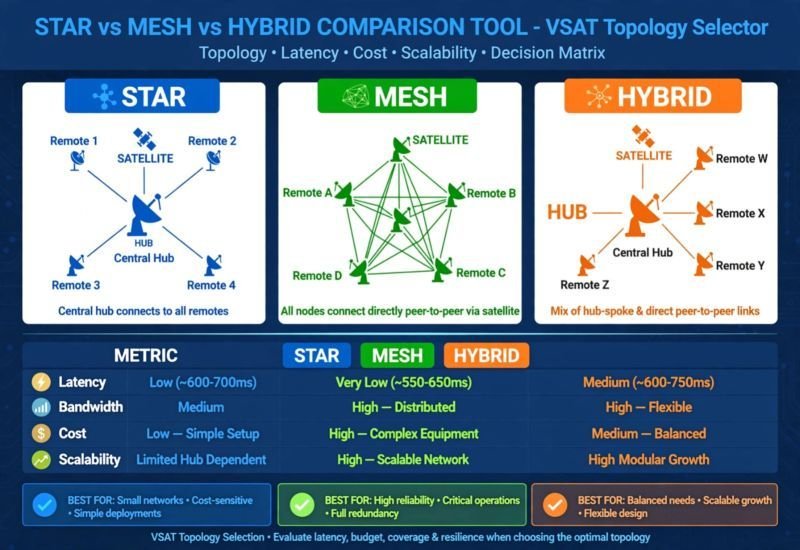
Star vs. Mesh vs. Hybrid Comparison Tool helps you compare satellite network topologies, explore their advantages and differences, and understand which architecture fits different VSAT applications.
🔄 Star vs. Mesh vs. Hybrid Comparison Tool
Simulator #11 — Interactive Side-by-Side Topology Comparison (Page 4, §2.2.4)
🧭 Select Topology for Detailed Analysis
⚙️ Configuration Parameters
📊 Metric Comparison
🤖 AI Recommendation Engine
📋 Complete Comparison Table
| Parameter | Star | Mesh | Hybrid |
|---|---|---|---|
| Topology Type | Star | Mesh | Hybrid |
| Hub Required | Yes | No (partial) | Yes (partial) |
| Links (N=10) | 10 | 55 | ~20 |
| Cost Level | LOW | VERY HIGH | MEDIUM |
| Redundancy | None | Full | Partial |
| Single Point Failure | Hub is SPOF | None | Reduced |
| Scalability | Easy | Complex | Good |
| Installation | Simple | Complex | Moderate |
| Maintenance | Low | High | Medium |
| Latency | Low | Variable | Low-Med |
| Bandwidth Efficiency | Shared | Dedicated | Mixed |
| Best Application | Broadcast, Enterprise | Military, Gov | Enterprise, SNG |
| Typical Cost (10 nodes) | $130K | $1.2M | $320K |
| Reliability | 99.0% | 99.99% | 99.9% |
💰 Cost Analysis (Live)
🗺️ Topology Visualization
📈 Cost vs. Number of Terminals (All Topologies)
📚 ITU References & Source Documentation
1. ITU-R Recommendation M.1036 — "Satellite Earth stations and systems — Orbital and sub-system parameters"
Section §3 defines standardized network topology parameters including star, mesh, and hybrid configurations. Provides link count formulas, node requirements, and the comparison framework used in this tool. Section §3.2.4 specifically addresses topology selection criteria for VSAT networks.
2. ITU-R Recommendation S.740 — "Intermodulation products in satellite services"
Defines network topology standards and link budgets for VSAT networks. Section §4 specifies the relationship between network configuration, link costs, and transponder utilization. Establishes cost models for different topology configurations and their impact on system performance.
3. ITU-R Recommendation P.618 — "Propagation effects relevant to satellite service"
Section §4 covers satellite link parameters used in network design. Provides the framework for calculating link budgets, G/T ratios, and availability requirements that vary by topology type. Defines link redundancy requirements for different reliability targets.
4. ITU-R Recommendation P.2575 — "Key characteristics and test methods for earth stations"
Defines availability targets (99.5%–99.99%) that influence topology selection. Specifies performance requirements for different VSAT network configurations including uptime, latency, and redundancy standards.
5. ITU-R Recommendation W.46 — "Space stations and systems"
Provides the framework for satellite network planning, including network design rules, topology selection guidelines, and interference management between multiple VSAT networks.
6. Book Reference: "VSAT, SCPC/DAMA Systems: Parameters, Dependencies & ITU Formulas"
Chapter 2, Section 2.2.4 (Topology Comparison), page 4. Provides the detailed comparison table for Star, Mesh, and Hybrid topologies including cost estimates, reliability metrics, scalability analysis, and application recommendations. Section 2.2 provides the foundational topology definitions used throughout this simulator.
Cost Model Reference Values
Terminal Cost (Ct): $2,000–$15,000 | Hub Cost (Ch): $10,000–$100,000 | Link Cost (Cl): $200–$5,000/km | Star Links: N | Mesh Links: N(N−1)/2 | Hybrid Links: ~N × 1.5–2.5