
 Posted by
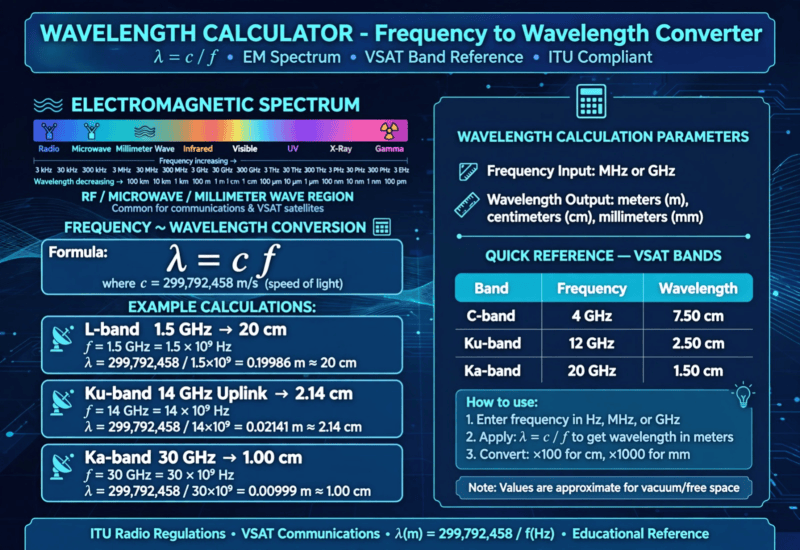
 Wavelength Calculator
Use the Wavelength Calculator to calculate wavelength from frequency and wave speed for radio, wireless, satellite, and electromagnetic communication applications.
📏 Wavelength Calculator
Simulator #7 — λ = c/f, Antenna Sizing & Friis Equation Application
📡 Frequency Input
📊 Wavelength Results
📐 Antenna Size vs. Wavelength
🌈 Electromagnetic Spectrum
| Band | Freq Range | λ Range | Antenna Size | VSAT Use |
|---|
📈 Wavelength vs. Frequency
🔗 Friis Transmission Equation
📚 ITU References & Source Documentation
1. ITU-R Recommendation P.618 — "Propagation effects relevant to satellite service"
Section §6 provides the free-space path loss equation: L_fs = 92.45 + 20log₁₀(f_GHz) + 20log₁₀(d_km). Section §7 addresses atmospheric attenuation which depends on wavelength and frequency. The Friis transmission equation is fundamental to satellite link budget analysis.
2. ITU-R Recommendation P.2109 — "Propagation data and prediction methods required for the design of earth stations"
Provides the physical derivation of free-space path loss from electromagnetic wave propagation theory: L_fs = 20log₁₀(4πd/λ). Establishes the fundamental relationship between distance, wavelength, and signal attenuation.
3. ITU-R Recommendation P.2575 — "Key characteristics and test methods for earth stations"
Defines the receive performance standards for different frequency bands, including the G/T ratio and required C/N₀ values that depend directly on wavelength and antenna gain.
4. ITU-R Recommendation M.1036 — "Satellite Earth stations and systems — Orbital and sub-system parameters"
Provides standardized antenna parameters including gain formulas, beamwidth calculations, and physical antenna dimensions for different frequency bands used in VSAT systems.
5. ITU-R Recommendation S.740 — "Intermodulation products in satellite services"
Addresses nonlinear effects that depend on antenna dimensions relative to wavelength, particularly for high-power transponders.
6. Book Reference: "VSAT, SCPC/DAMA Systems: Parameters, Dependencies & ITU Formulas"
Chapter 4, Sections 4.2–4.5 (Link Budget Analysis), page 7. The Friis equation P_r = EIRP × G_ant × (λ/4πd)² is central to all satellite link budget calculations, and wavelength directly determines antenna physical dimensions.
Key Constants
c (speed of light): 299,792,458 m/s | GEO distance: 35,786 km | Half-wave dipole factor: 1.42 × λ/2 (due to end effects) | Quarter-wave monopole factor: 0.95 × λ/4 | π: 3.14159265359