
 Posted by
 FEC Coding Gain Calculator
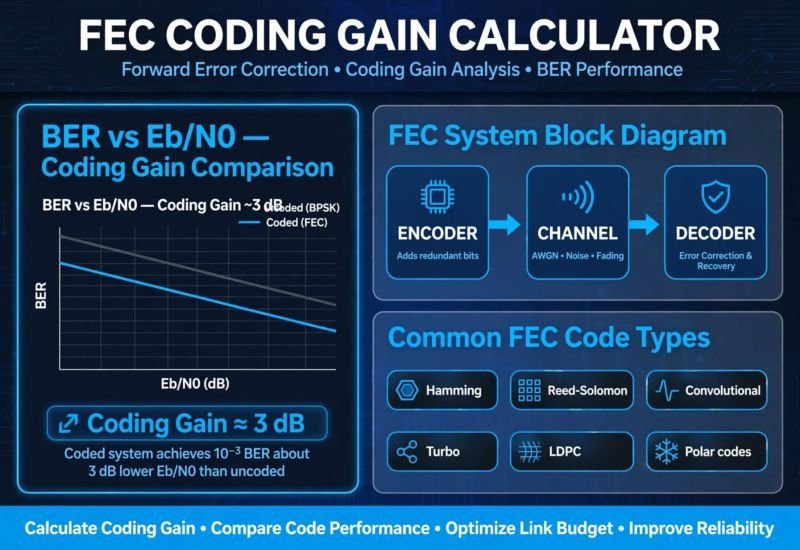
FEC Coding Gain Calculator: Calculate coding gain for Hamming, Reed-Solomon, Convolutional, Turbo, LDPC & Polar codes. Compare BER vs Eb/N0 performance.
📐 FEC Coding Gain Calculator
Compare Forward Error Correction Schemes — ITU-R BS.1111 Compliant
Coding Gain = (Eb/N₀)_uncoded − (Eb/N₀)_coded
⚙️ Configuration
Convolutional
Rate 1/2
Turbo
Rate 1/2
LDPC
Rate 1/2
Uncoded BPSK
Rate 1
Convolutional (2,1,7): Constraint length K=7, rate R=1/2.
Well-known code with coding gain ~4–5 dB at BER 10⁻⁵.
Viterbi decoding provides optimal soft-decision performance.
Coding Gain
0.0
dB improvement
Uncoded BPSK
9.60
Reference
Convolutional
—
—
Turbo Code
—
—
LDPC
—
—
📈 BER vs. Eb/N₀ — Coded vs Uncoded
📐 Code-Specific Formulas & Thresholds
Convolutional Code (2,1,K)
G(D) = [1, 1+D+D²] for K=7
Free distance d_free determines performance. Soft-decision Viterbi decoding. Coding gain ≈ 4.1 dB (K=7, R=1/2) at BER=10⁻⁵.
Turbo Code (Parallel Concatenated)
BER ≈ f(R, N_iter, d_free₁, d_free₂)
Two recursive systematic convolutional encoders + interleaver. Iterative MAP/BCJR decoding approaches Shannon limit. Coding gain ≈ 8.9 dB at BER=10⁻⁵.
LDPC (Quasi-Cyclic)
BER ≈ f(R, N, d_min, column weight)
Sparse parity-check matrix H. Belief propagation decoding. Near-Shannon limit performance. Coding gain ≈ 9.1 dB at BER=10⁻⁵.
Uncoded BPSK (Reference)
BER = ½ · erfc(√(Eb/N₀))
Baseline performance without any coding. Requires Eb/N₀ = 9.6 dB for BER = 10⁻⁵. Serves as reference for computing coding gain.