
 Posted by
 Modulation Comparison Table Generator
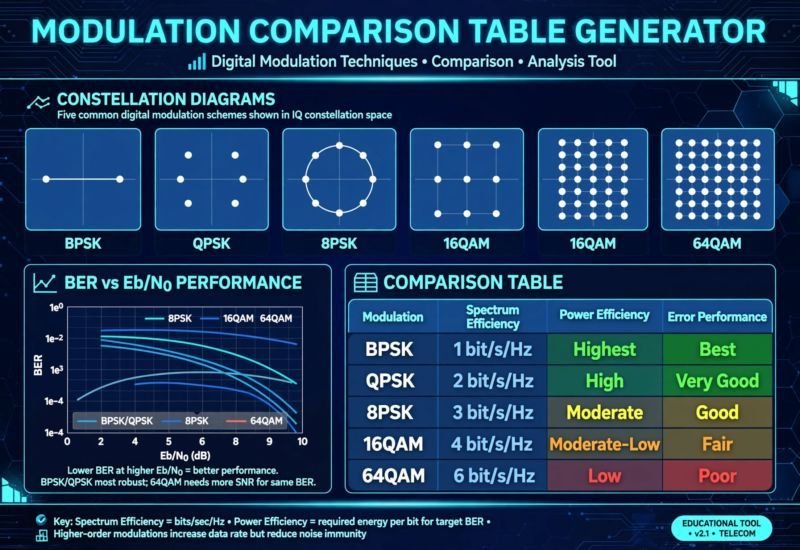
Modulation Comparison Table Generator: Compare BPSK, QPSK, 8PSK, 16QAM, 64QAM on spectrum efficiency, power efficiency, BER vs Eb/N0 and error performance.
📊 Modulation Comparison Table Generator
Interactive Trade-off Analysis for Digital Modulation Schemes
📋 Modulation Scheme Comparison
| Scheme ⇅ | M-Order ⇅ | Bits/Symbol ⇅ | η (bits/s/Hz) ⇅ | Min Eb/N₀ (dB) ⇅ | BW Efficiency ⇅ | Decoding Complexity ⇅ | BER Robustness ⇅ | Typical Use ⇅ |
|---|
📐 Key Trade-off Insights
📈 Efficiency vs. Robustness
Higher-order modulations pack more bits per symbol, achieving higher spectral efficiency but requiring significantly higher Eb/N₀ for the same BER. Lower-order schemes are more robust to noise.
🎯 BER Performance (AWGN)
BPSK/QPSK ≈ 10.5 dB, 8-PSK ≈ 13.5 dB, 16-QAM ≈ 14 dB, 64-QAM ≈ 17 dB, 256-QAM ≈ 20 dB for BER = 10⁻⁵.
⚙️ Complexity Scaling
Demodulation complexity increases with M. QAM requires both I and Q channel detection. Higher-order needs more precise carrier recovery and channel estimation.
📡 Real-World Applications
BPSK: Deep space, GPS. QPSK: Wi-Fi, satellite. 16/64-QAM: Cable, LTE. 256-QAM: 5G, DOCSIS 3.1. APSK: DVB-S2.