
 Posted by
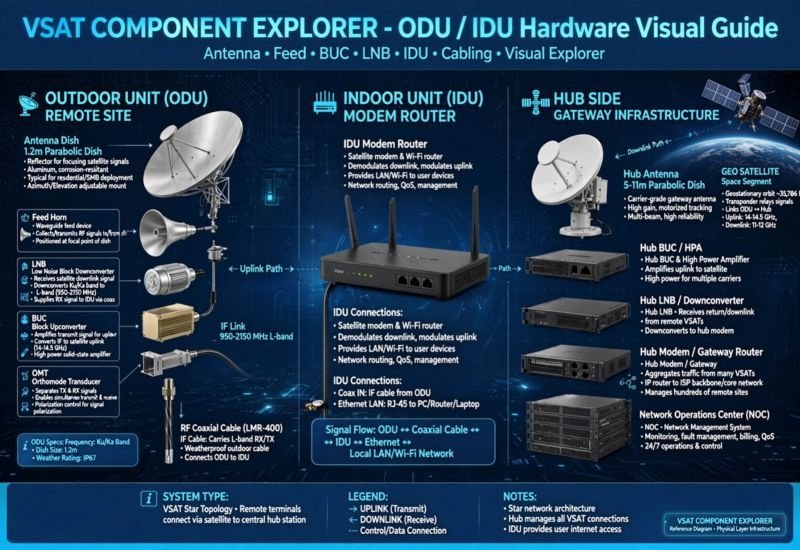
 VSAT Component Explorer
VSAT Component Explorer helps you explore key VSAT components, understand their functions, and learn how antennas, modems, amplifiers, and other satellite system parts work.
🔧 VSAT Component Explorer
Simulator #10 — Interactive Exploded Diagram: ODU, IDU & Hub Station
🧩 Select Component
🏗️ VSAT Station Exploded Diagram
📋 Component Specifications
| Parameter | Value |
|---|
📡 Frequency Plan & Signal Flow
Uplink Signal Chain
| Stage | Component | Freq | Gain/Loss |
|---|---|---|---|
| TX | Router → Modem → BUC | L → C / Ku / Ka | + |
| Amp | BUC (Block Upconverter) | 70 MHz → 14 GHz | +40 dBW |
| Ant | ODU Antenna | Band-specific | +35 dBi |
| Path | Free Space | Variable | −Lfs |
| Rx | Satellite | — | Transponds |
Downlink Signal Chain
| Stage | Component | Freq | Gain/Loss |
|---|---|---|---|
| Rx | ODU Antenna | Band-specific | +35 dBi |
| LNA | Low Noise Amplifier | 1–2 GHz (L-band) | +40 dB |
| Path | Free Space | Variable | −Lfs |
| Demod | IDU Modem | Baseband | − |
| Output | Router → Network | Ethernet/RS232 | — |
📚 ITU References & Source Documentation
1. ITU-R Recommendation P.618 — "Propagation effects relevant to satellite service"
Section §4 defines the G/T ratio and system noise temperature for VSAT earth stations. Section §7 covers rain attenuation affecting LNA and BUC performance. Section §6 provides the Friis transmission equation fundamental to all component specifications.
2. ITU-R Recommendation P.2109 — "Propagation data and prediction methods required for the design of earth stations"
Provides antenna gain calculations, EIRP determination, and the physical derivation of free-space path loss. Defines antenna aperture efficiency and diameter relationships used in ODU specification.
3. ITU-R Recommendation S.740 — "Intermodulation products in satellite services"
Defines BUC linearity requirements, third-order intermodulation standards, and operating back-off requirements. Specifies that BUCs must operate with sufficient IBO to prevent spectral regrowth.
4. ITU-R Recommendation M.1036 — "Satellite Earth stations and systems — Orbital and sub-system parameters"
Provides standardized parameters for VSAT components including antenna diameter ranges, G/T specifications, EIRP output levels, and BUC power requirements for different frequency bands.
5. ITU-R Recommendation P.2575 — "Key characteristics and test methods for earth stations"
Defines the receive performance standards including C/N₀ thresholds, G/T minimum values, and antenna pointing accuracy requirements for different VSAT component configurations.
6. Book Reference: "VSAT, SCPC/DAMA Systems: Parameters, Dependencies & ITU Formulas"
Chapter 2, Section 2.3 (VSAT Components), page 4. Defines ODU (Outdoor Unit) including BUC and LNA, IDU (Indoor Unit) including Modem and Router, and Hub Station components. Provides component specifications, interconnections, signal flow diagrams, and typical values for all VSAT subsystems.
Component Reference Values
BUC Output: 20–60 dBW (C-band), 35–55 dBW (Ku), 30–50 dBW (Ka) | LNA Noise Fig: 0.5–1.5 dB | Antenna Gain: 34–48 dBi | Modem BER: ≤ 10⁻⁶ | Typical G/T: 30–48 dB/K | EIRP: 40–58 dBW